
A Journey to Well-Being
In many parts of modern society, wellness has been turned into something we need permission to access, or must be productive and valuable enough to earn. What was once understood as a human right has been reframed as an individual achievement or a luxury reserved for those who can afford it or prove they deserve it.
When wellness is treated this way, healing becomes transactional rather than human-centred. Self-care and personal well-being become something out of reach, instead of something woven into everyday life.
To reclaim wellness, we must move away from the corporate framing of “buying” our well-being and return to an understanding that wellness is shaped by the conditions we live in. We are shaped by our environments, our relationships, our histories, and our responsibilities to one another.
When the land is unwell, when communities are under strain, and when systems are built on resource extraction rather than care, individual wellness cannot be separated from that reality. Living in a commodity-focused culture inevitably shapes how we treat ourselves, how we define self-care, and what we believe we are allowed to need.
This way of thinking has even shaped how we understand foundational ideas about human needs.
The Misunderstood Pyramid
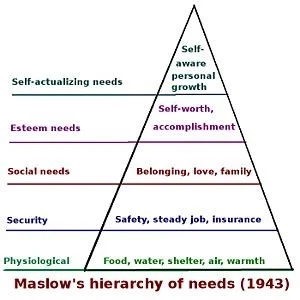
In Western textbooks and training manuals, Maslow’s Hierarchy of Needs is usually shown as a pyramid. While this image is familiar, it is not how Maslow originally presented his ideas. The pyramid shape appeared later, developed to make the theory easier to use in corporate, organizational, and workplace settings.
When shown this way, the pyramid model can suggest that human growth is linear, that one need must be fully met before another can begin, with self-actualization placed at the top and appearing disconnected from the relational and environmental supports that make well-being possible.
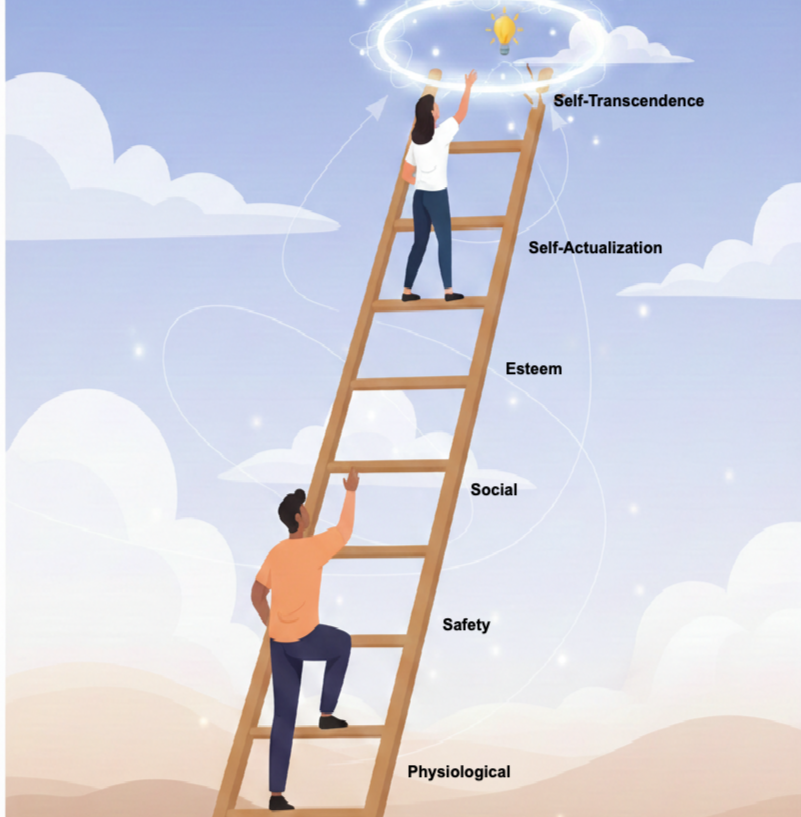
Less often discussed is that later in his life, Maslow reflected on how his work had been simplified. He expanded his thinking to include self-transcendence, recognizing that fulfillment does not stop at the self. Meaning, connection, and contributing to something beyond oneself are also central to human well-being.
Rather than a rigid pyramid, Maslow’s work may be better understood as a ladder. People can have some needs met while others remain unmet, and movement between them depends on safety, relationships, environment, and circumstance. We move back and forth between needs as life changes. Well-being and human needs are not a checklist or a linear sequence, but living systems shaped by many influences at once.
Indigenous Ways of Knowing
What is rarely acknowledged is that Maslow’s work was influenced by the Siksika (Blackfoot) Nation’s understandings of wellness.
In these teachings, human well‑being is not hierarchical in a competitive sense, nor is it centered on individual achievement alone. Wellness is woven through our relationships, our actions, and our responsibilities to one another.
-
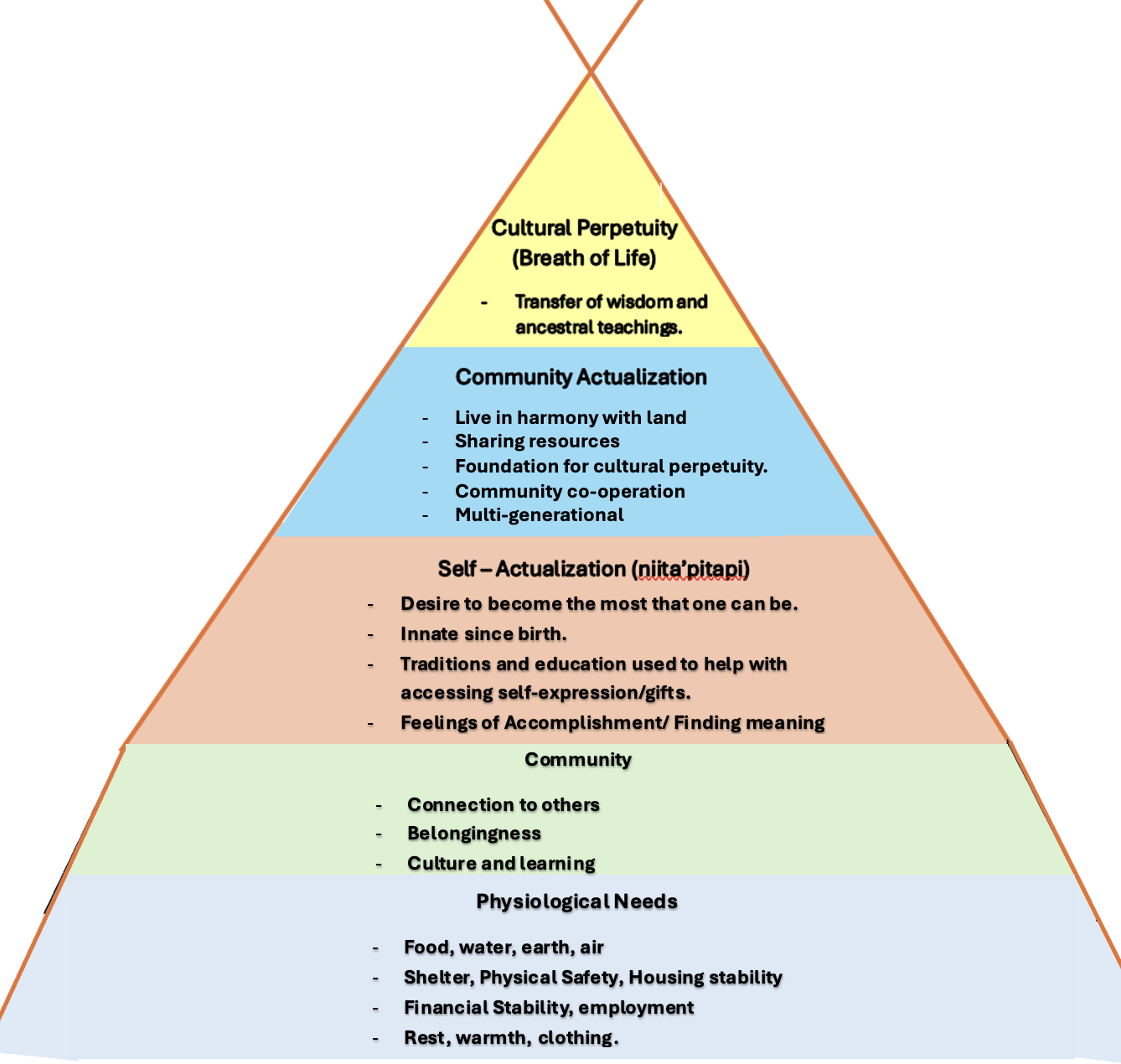
In Blackfoot teachings, self-actualization is not a reward at the end of life; it is the foundation. Like the base of a Tipi, it represents an individual’s responsibility to understand their gifts, strengths, and purpose. This is not about self-promotion, but about knowing how one is meant to contribute. When the base is strong, the structure can stand.
-
Once the self is grounded, attention turns outward. Wellness is not just for personal fulfillment; it is also about showing up for our families, communities, and relations. Growth is never separate from responsibility. We develop ourselves so that the collective can thrive.
-
Where Western interpretations often stop at the individual, Blackfoot philosophy goes further. The highest point of the Tipi reaches toward the stars and represents Cultural Perpetuity, living in a way that ensures culture, language, values, and wisdom continue for the next seven generations. This is the fullest expression of wellness: not what we accumulate, but what we sustain and pass on.
Want to know more?
Path to Wellness
Before you can carve your path to improved well-being, we must first understand and define wellness for ourselves. How you define wellness and the path to it is deeply personal.
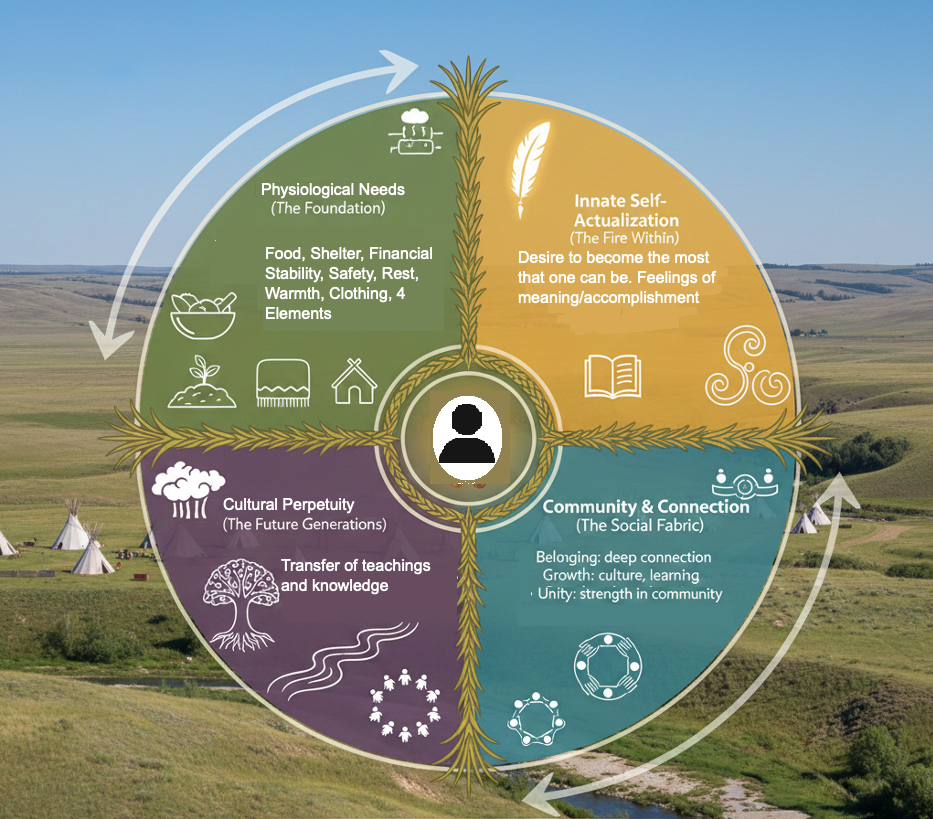
We can imagine wellness as a Tipi, with each pole necessary, leaning on the others, and grounded by a shared foundation. Or we can see it as a circle, where needs are interconnected rather than ranked, and balance is restored again and again through relationship, care, and responsibility.
Wellness is not something to perfect. It is a way of living, practiced daily through care, connection, and attention to ourselves and those around us. The focus is on the journey and on committing to try, rather than on achieving a perfect outcome.
Discover how you define wellness with our short quiz.
When you are ready, connect with us to explore your personal path forward.
Inspired by Siksika Nation, Dr. Cindy Blackstock and Abraham Maslow